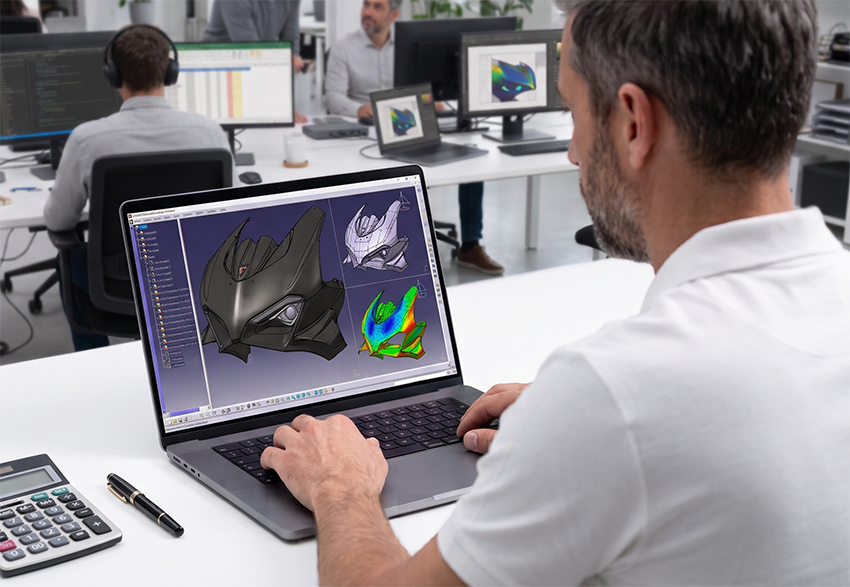
Bridging pure engineering discipline with visionary industrial design requires an uncompromising approach to physical prototyping. Within conceptual development frameworks for advanced hyper-performance motorcycle platforms, physical scale models serve as essential validation tools where aerodynamic theory, ergonomic geometry, and Class-A surfacing seamlessly collide. Achieving this level of structural fidelity demands absolute continuity between parametric CAD data and tangible materials.
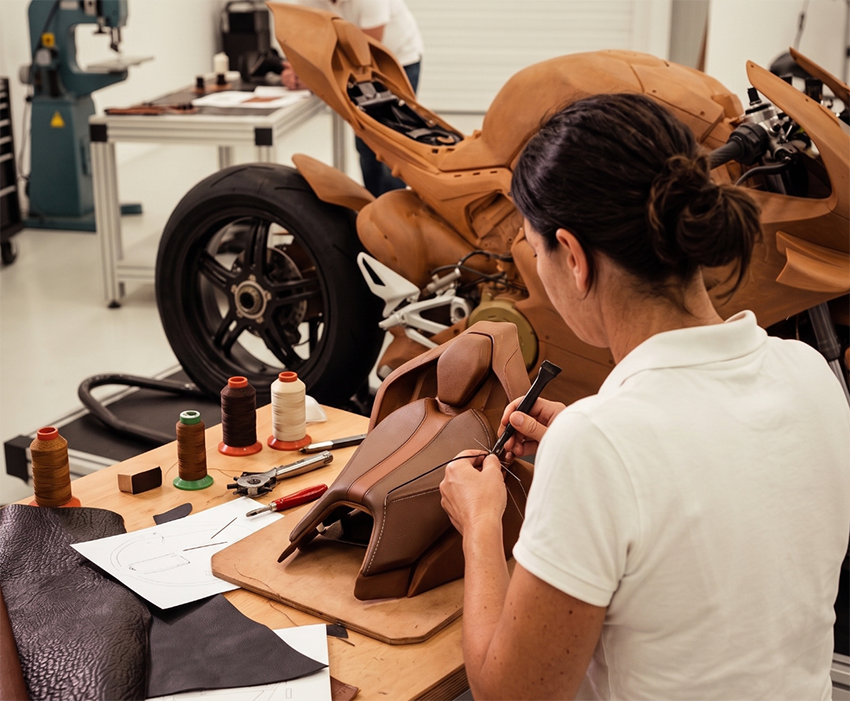
Every surface contour on a conceptual study serves a dual purpose: directing airflow and defining spatial character. Achieving this balance relies on tight integration across digital topology optimization, multi-axis machining, and bespoke hand-finishing.
- Class-A surfacing and generative topology: Sub-D modeling and stress-driven algorithms strip excess mass, optimizing structural load paths along the motorcycle chassis while sculpting raw aerodynamic forms.
- Sub-millimeter CNC substrate carving: 5-axis dynamic milling transfers exact CAD surfaces directly onto high-density polyurethane and clay substrates, maintaining critical structural boundaries and panel tolerances.
- Clay-model hand sculpting: Master modelmakers shape and refine industrial styling clay over structural armatures, using specialized light arrays to perfect tank transitions, fairing curves, and aerodynamic highlights.

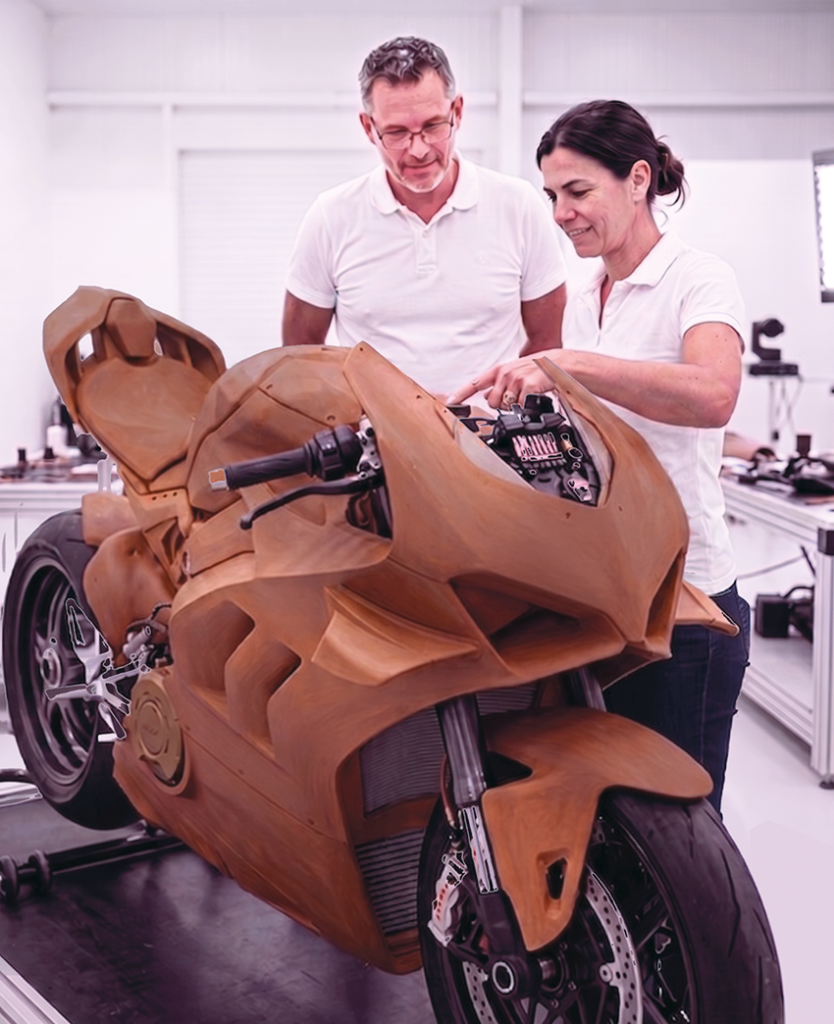
- Bespoke leather work and saddle tailoring:Hand-stitched leather work integrates custom ergonomics and rider contact points directly into the frame geometry for precise validation of seating position and control reach.
Multi-stage paintjob and surface finishing: High-build primers, deep metallic base coats, and multi-layer clear coats are meticulously applied to highlight panel transitions and test light reflection across every compound curve.
 Hybrid additive integration: SLA and SLS rapid prototyping allow functional components—such as micro-intake grids, downforce winglets, and internal ducting—to be dry-fitted and validated directly against the primary form.
 Hybrid additive integration: SLA and SLS rapid prototyping allow functional components—such as micro-intake grids, downforce winglets, and internal ducting—to be dry-fitted and validated directly against the primary form.
Engineered for display, validated for production
From early structural armatures through clay modeling to multi-stage surface treatments, every phase of exploratory motorcycle development focuses on execution accuracy. Industrial designers gain complete fidelity to their original vision, while systems engineers obtain physical proof of packaging feasibility, thermal management clearances, and assembly sequencing.
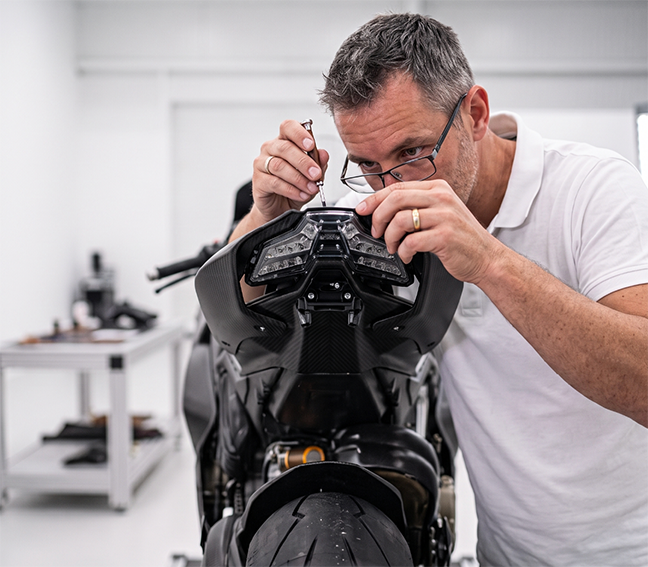
The result is a physical design artifact that validates aerodynamic intent, respects hard manufacturing constraints, and meets the rigorous standards of advanced engineering teams.